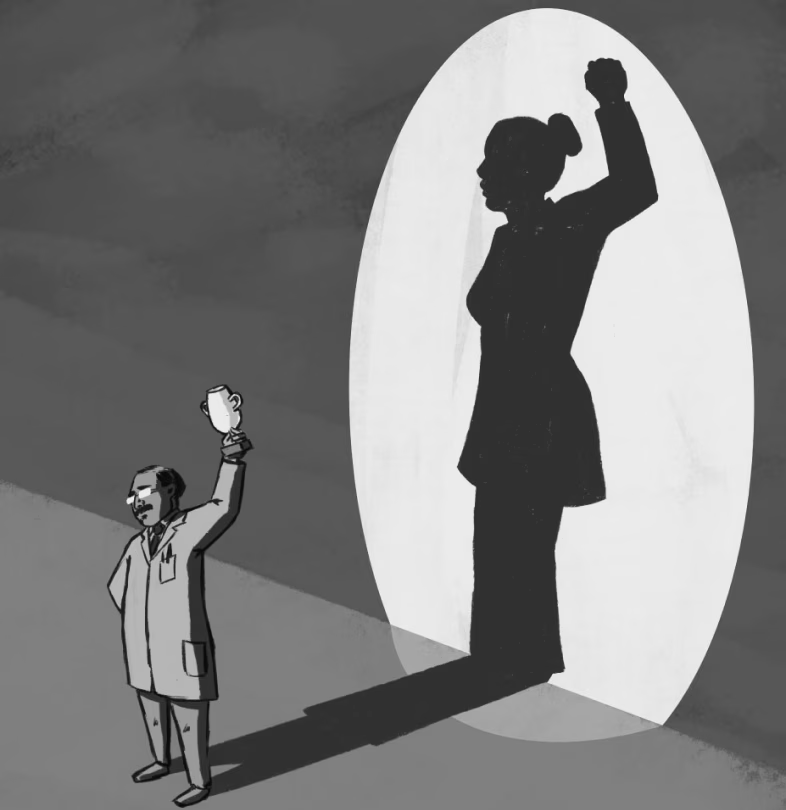
Their discoveries changed the world, yet their names have often vanished from textbooks.
The Matilda Effect refers to a longstanding bias that systematically erases women scientists, attributing their work to men or simply forgetting their achievements
It is as much a systemic phenomenon as an unfair one, and its traces are still felt today.
Origins of a Forgotten Term
The expression “Matilda Effect” was coined in 1993 by Margaret W. Rossiter, a sociologist of science.It honors Matilda Joslyn Gage (1826–1898), a nineteenth-century American feminist and trailblazer for women’s rights and their place in science.
Gage had already denounced, long before her time, the systematic exclusion and dispossession of women inventors and researchers.
Rossiter later gave this persistent bias its name: the idea that women’s contributions to scientific research are diminished, denied, or reassigned to others.

Engraving of Matilda Joslyn Gage - 19th century
A Mechanism of Invisibility
The Matilda Effect isn’t caused by one single factor-it's built from a web of cultural and institutional mechanisms:
- Historical exclusion of women from universities, labs, and academies.
- Gender biases that associate scientific rigor with inherently masculine qualities.
- Unequal credit structures where men receive recognition for contributions in hierarchical systems.
- Media coverage that glorifies male figures while sidelining female collaborators.
“Our entire system was somehow rigged against them... You rarely found a man or anyone who encouraged them.”
This process is a slow erosion of collective memory: women’s discoveries are diluted in scientific narratives until they disappear altogether.

Photographie de Margaret W. Rossiter
Lasting Consequences
The Matilda Effect is more than symbolic injustice: it has real impacts on science and society.
- It discourages young women from pursuing scientific careers due to a lack of visible role models.
- It undermines diversity, slowing progress and innovation.
- It rewrites science’s history with a masculine bias.
Recent studies confirm women’s co-signed articles are cited less, and scientific prizes remain vastly awarded to men—even in mixed fields.
Scientists to Rediscover
Countless women scientists over the decades have suffered collective neglect ; a timeline is available to explore them
These women—sometimes referred to as “Matildas”—led major advances in physics, mathematics, biology, and astronomy.
Their present-day recognition relies on historical rehabilitation : documentaries, books, exhibitions, and educational projects finally restore both faces and names to these pioneers.
An Ongoing Struggle
Mindsets are changing, but the challenge of the Matilda Effect is not over.Today’s women scientists must still fight for fair acknowledgment, funding, and parity in institutions.
Exposing this bias is also a call to reflect on how science itself is written: who gets to speak, who discovers, and - most importantly - who is cited?