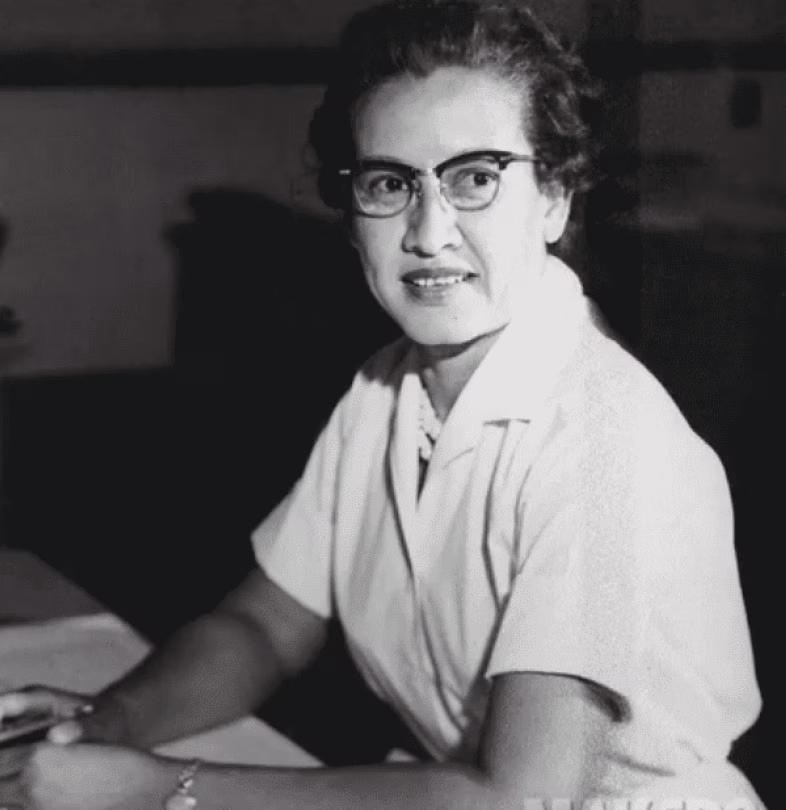
Katherine Coleman Johnson (1918–2020) is a major figure in the history of American aerospace, although for decades, her name remained in the shadows.
This article traces her journey - from her early brilliance in mathematics to her years at NASA- highlighting her scientific contributions, the racial and gender barriers she faced, and the long road to overdue recognition.
Early Life: The Awakening of a Mathematical Mind
Katherine was born August 26, 1918, in White Sulphur Springs, West Virginia.
Her love for numbers revealed itself early: her exceptional mathematical talent saw her skip grades.
She finished high school at the age of 14 and went on to attend West Virginia State College, where she earned a bachelor's degree in mathematics and French in 1937, at the age of 18.
She taught math at high schools in West Virginia before being recruited in 1953 by NACA (the precursor to NASA).
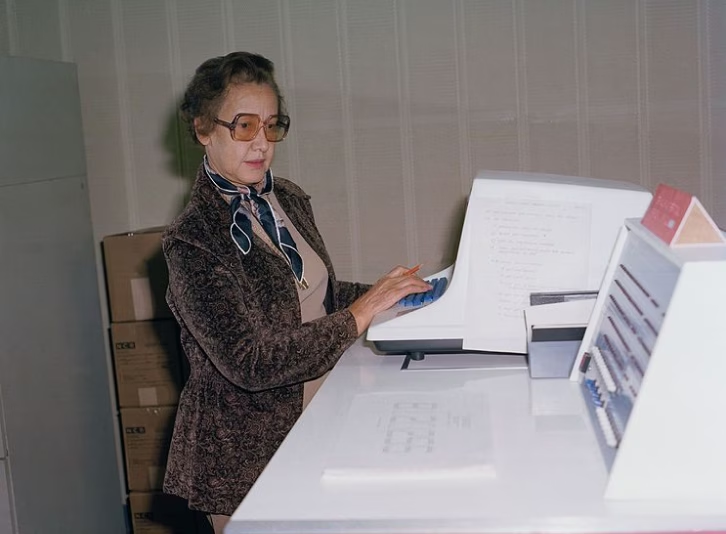
Photography of Katherine Johnson at work at the Langley Research Center
At NASA/NACA: Challenges and Calculations
Lorsque Katherine Johnson intègre la NACA (à Langley), elle rejoint un groupe de “human computers” - women mathematicians tasked to manually perform scientific and technical calculations.
At that time, the “Jim Crow laws" laws imposed strict segregation between white and Black people in many public spaces.
At the Langley lab, Black women mathematicians were assigned to a separate section-the West Area Computing Unit.
“Back then, women had to assert themselves—with confidence and aggression—and how much you asserted depended on where you were. I had to do it.”
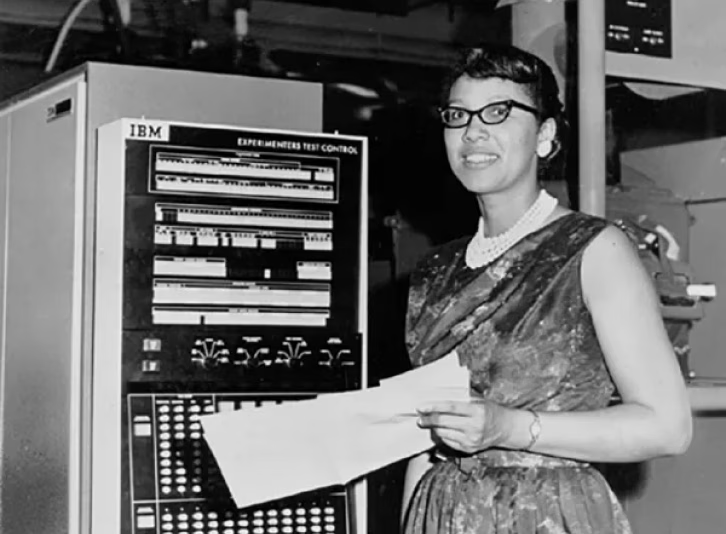
Photograph of Katherine Johnson in the West Area Computing Unit
This separation was more than physical: it embodied institutional obstacles.
Black women had to prove their skills repeatedly, confront both racial and gender prejudice, and work in environments where their technical presence was challenged outright.
Nevertheless, Johnson and her colleagues gradually broke these barriers - they were eventually invited to join mixed teams, attend technical meetings, and collaborate on high-profile projects.
Still, their essential calculations often went unrecognized in official accounts of the space race.
Hidden in the Shadows: Credits and Recognition
Mainstream narratives for decades focused on astronauts, engineers, and project leaders—usually white men—while the “human computers,” especially Black women, were rarely credited or only mentioned indirectly.
Johnson herself appeared infrequently in publications, press releases, or NASA’s early institutional records. Her vital contributions remained overlooked - an archetype of the Matilda Effect.
Only in the 2000s - and especially after the release of the book “Hidden Figures” (and its film adaptation) - did her name become widely known.
She received many honors, including the Presidential Medal of Freedom in 2015 from President Barack Obama, and today her story stands as a symbol of perseverance and restorative justice
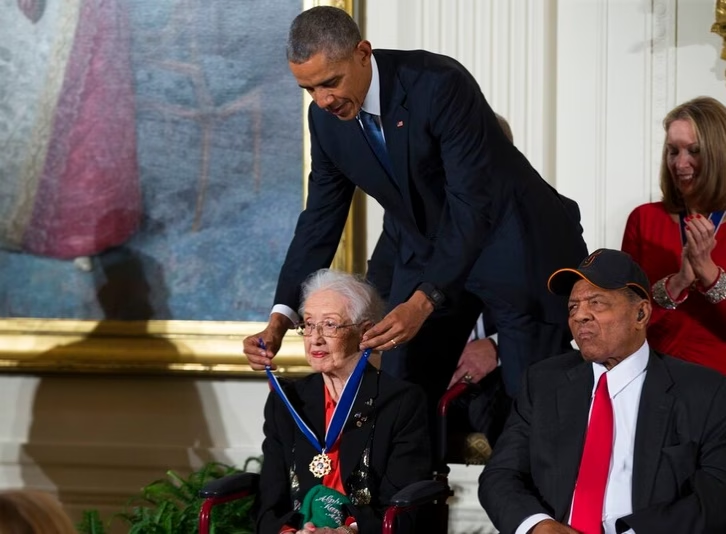
Photography of Katherine Johnson receiving the Presidential Medal of Freedom from Barack Obama in 2015
From Shadows to Light: The Symbolism of Katherine Johnson
From overlooked mathematician to true icon of female genius, Johnson’s name now embodies perseverance and the desire for scientific recognition.
She represents those pioneers who needed to prove themselves twice over - to be seen both as women and as Black women.
Although Johnson left a tremendous technical legacy, her impact goes far beyond the aerospace field.
Her rigor and precision continue to inspire women engineers and scientists - and entire generations of girls - with the message that they too belong in science and in history.
Her story forces us to reconsider how the history of science is written: Who is recognized, and who is excluded?
Telling Katherine Johnson’s story isn’t just about honoring a mathematician—it helps preserve the memory of all women left in the shadows.