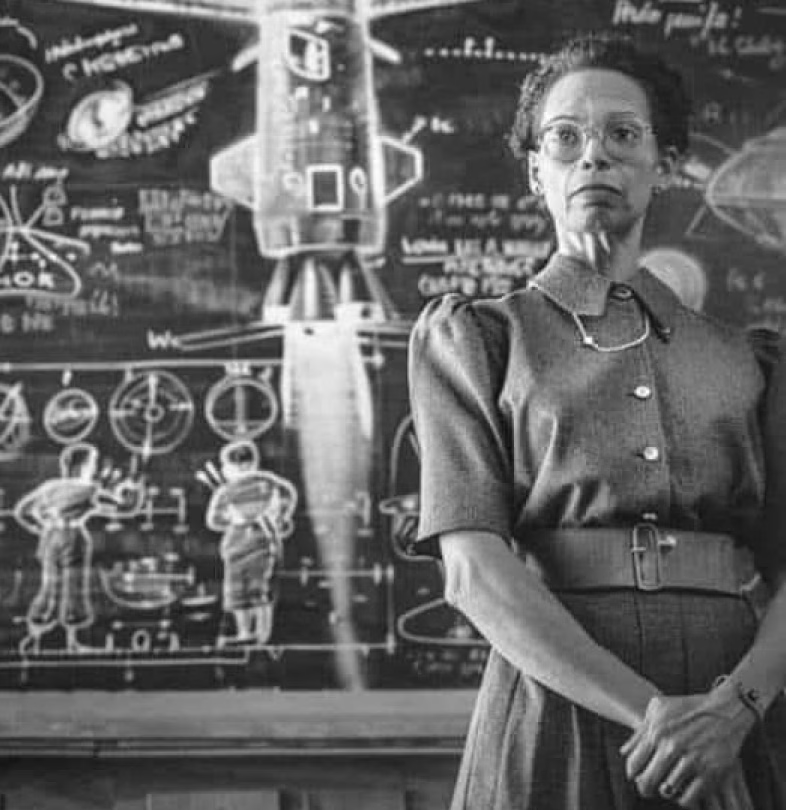
Johnson was far more than a “human computer”: she was one of the minds behind NASA’s most iconic spaceflight trajectories.
This article explains her research and achievements :
How she manually calculated flight paths, checked computer results by hand, and made possible the first crewed spaceflights, Apollo missions, and much more.
The Foundations: Calculating a Space Trajectory
Sending a rocket into space is not just aiming “upwards”.
It takes precise predictions of orbits, launch windows, ignition timing, reentry, and return trajectories.
Johnson did all of this by hand—with ruler, paper, pencil, and mechanical calculator—when computers were new and unreliable.
For example, for Alan Shepard’s (Freedom 7, 1961), Johnson calculated ascent and descent paths, accounting for gravity, air resistance, and more.
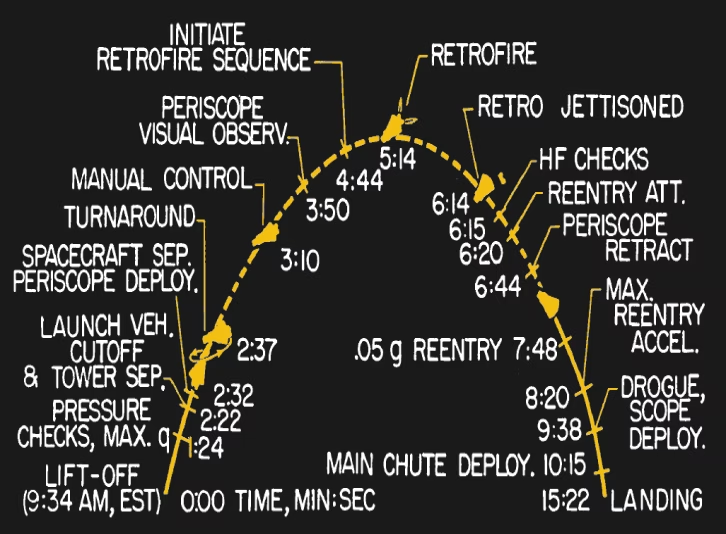
Alan Schepard's rocket trajectory diagram - created for the Freedom 7 mission
“If she says it’s good, I’m ready”: Computer Verification
When electronic computers appeared at the research center, some critical missions still relied on manual calculations.
During John Glenn’s orbital flight (Friendship 7, 1962), Glenn insisted that Johnson herself double-check the computer-generated numbers before he would fly, fearing undetected errors.
She redid the calculations herself, and all matched.
This moment highlights two things: the reliability of manual methods (despite limited technology) compared to computers,
and, above all, the trust placed in Johnson - despite her gender and skin color - in tense political and technical contexts.
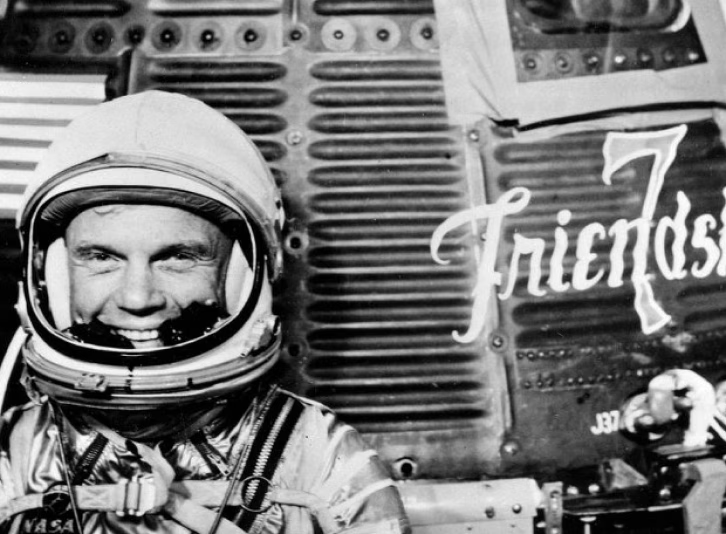
Photograph of John Glenn next to the Friendship 7 rocket
Apollo, the Moon, Rescues: Major Achievements
Some of her greatest contributions include:
- Apollo 11 (1969)Calculated key trajectories for the lunar mission, notably rendezvous paths between the lunar and service modules.
- Apollo 13 (1970)Her contingency plans informed navigation that aided in the crew’s safe return after mission failure.
- Mercury Projects (1958–1963)Launch windows, reentry paths, ocean splash coordinates, and more.
- Satellite Echo 1 (1960)Co-authored the first report on the orbital behavior of the Echo 1 communications satellite, factoring in solar pressure—a crucial perturbation for ideal trajectories.
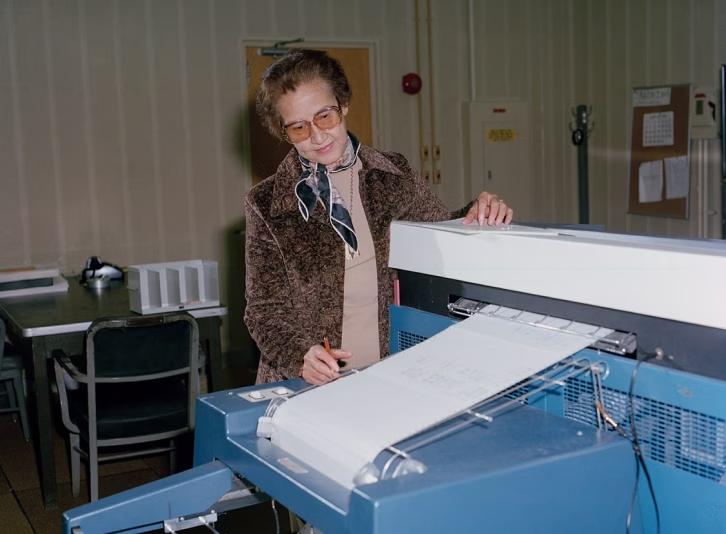
Photograph of Katherine Johnson using a calculating machine
Science and Math Behind Her Work
A few key concepts explained:
- Two-body models : (Earth-satellite / Earth-Moon) : Approximate gravity using two main bodies to predict orbits, launch windows, etc. - Johnson used these for baseline calculations.
- Perturbations : Atmospheric drag, solar radiation pressure, non-uniform gravity—all subtly alter expected paths and require corrections. (Echo I was an example for solar pressure.)
- Orbital rendez-vous : For Apollo, the lunar module had to leave the surface, reach, and dock with the main module—a task requiring precise calculations of speeds, angles, and timing, considering rotation and gravity.
Legacy: What Johnson’s Work Means Today
Even though computers now handle thousands of variables, much of Katherine Johnson’s foundational work remains relevant.
Her geometric reasoning, orbital trajectory calculations, consideration of perturbations, and insistence on rigor - manual or computational - continue to set standards.
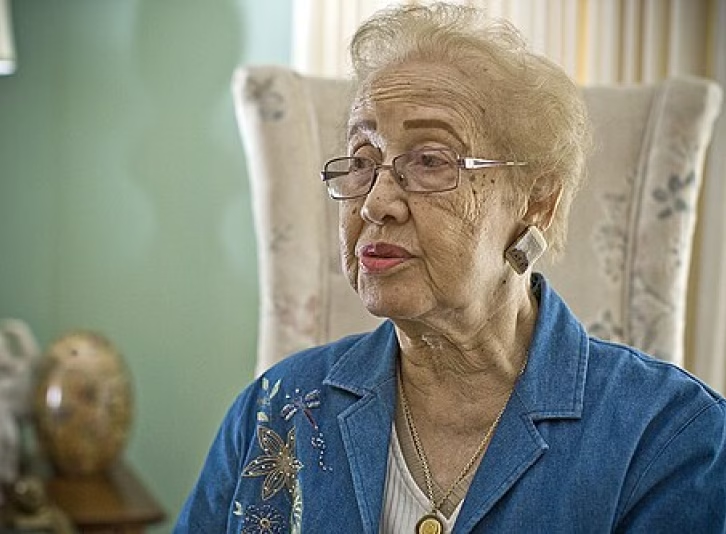
Photography of Katherine Johnson in 2008
Conclusion
Katherine Johnson’s calculations were far more than arithmetic - they were the linchpin of bold space missions, bridging the gap between theory and practice, turning the dream of spaceflight into reality.
Her approach displayed both elite scientific skill and remarkable determination when facing technical, social, and institutional hurdles.